
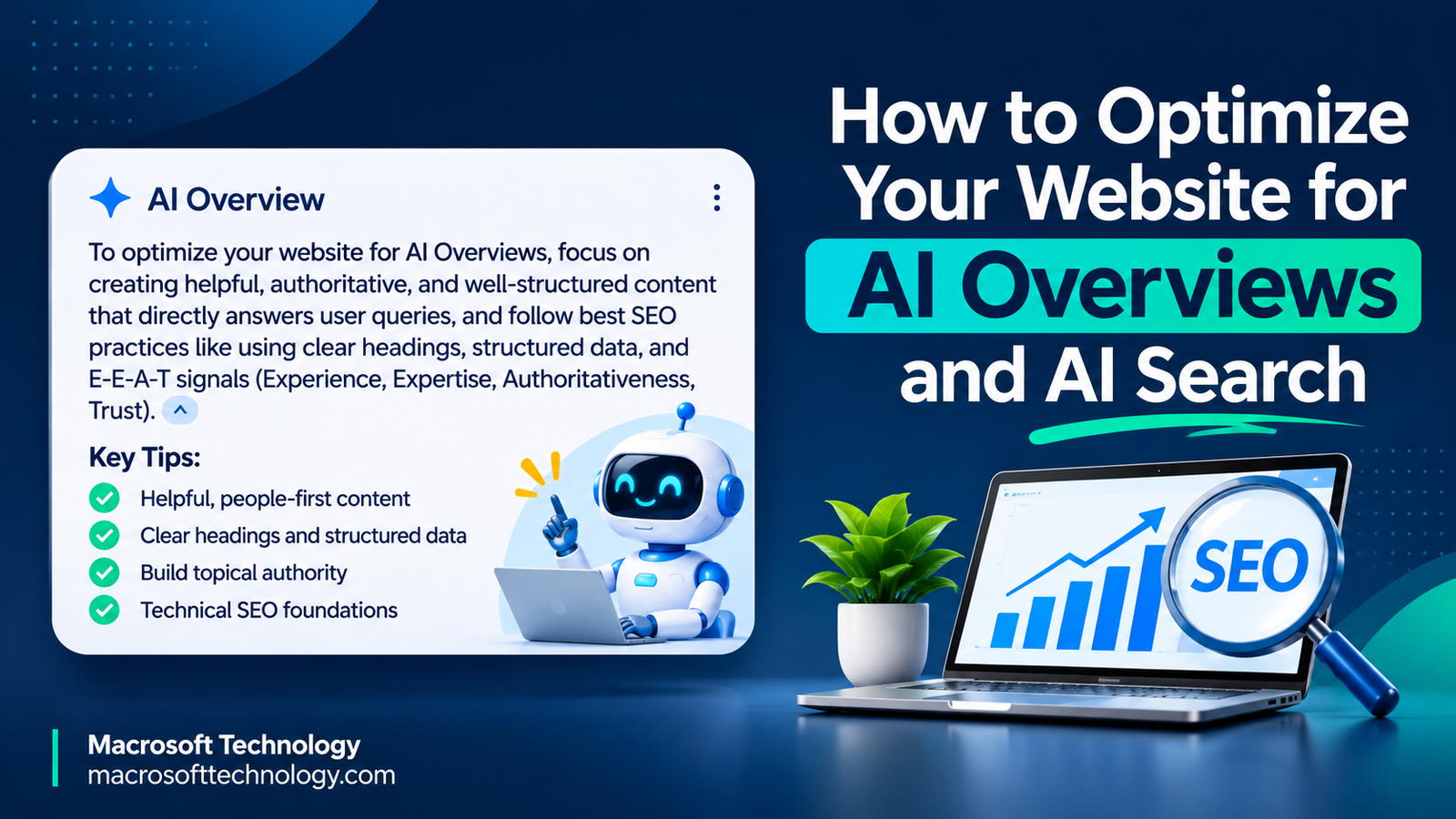
A few years ago, ranking on page one of Google was the goal. Today, many searches never reach page one at all. Google shows an AI Overview at the top, ChatGPT answers questions directly, and tools like Perplexity and Gemini summarize the web in seconds.
So here is the question every business owner is now asking: how do I make sure my website is the one these AI tools mention?
The good news is that you do not need a brand-new strategy. You need a sharper version of good SEO. In this guide, we walk through exactly what to do, step by step, in simple language.
What Are AI Overviews and AI Search?
AI Overviews are AI-generated summaries that Google shows at the top of some search results. They answer the question directly and include links to the websites the answer was based on.
AI search is a wider idea. It includes Google’s AI features, ChatGPT search, Perplexity, Microsoft Copilot, and similar tools. Instead of giving a list of ten links, they read many pages, combine the information, and give one answer with sources.

For your business, this means two things:
-
Your website must still rank well so AI tools can find it.
-
Your content must be clear and trustworthy enough to be quoted.
If you want the bigger picture on why clicks are changing, read our earlier post: AI Overviews reducing clicks.
Do You Need a Special Kind of SEO for AI?
Not really. Google has said that the same fundamentals that help you in normal search also apply to its AI features. There is no secret tag or magic file that forces your site into an AI Overview.
What changes is the quality bar. AI systems pick content that is:
-
Easy to understand
-
Factually accurate
-
Written by someone with real experience
-
Well organized and easy to quote
That is why strong, professional SEO services are still the foundation, even in the AI era.
Step 1: Make Sure AI Tools Can Access Your Website
Before anything else, check the basics. If search engines and AI crawlers cannot read your site, nothing else matters.
Quick technical checklist:
-
Your important pages are indexed in Google (check in Google Search Console)
-
Your robots.txt file is not accidentally blocking Googlebot
-
Your pages load fast and pass Core Web Vitals
-
Your website is mobile-friendly
-
Key content is in plain HTML text, not hidden inside images or heavy scripts
-
You have an up-to-date XML sitemap
Some AI tools use their own crawlers. If you want visibility in those tools, avoid blocking them without a clear reason.

Step 2: Answer Questions Directly (Answer First, Explain Later)
AI tools love content that gives a clear answer quickly. Think of every section as a mini answer box.
Weak example:
“There are many factors that can influence the cost of a website, and it really depends on a lot of things...”
Strong example:
“A basic business website in India typically costs between ₹15,000 and ₹60,000, depending on the number of pages, design, and features.”
How to apply this:
-
Put the direct answer in the first 1 to 2 sentences under each heading
-
Then add details, examples, and context
-
Use headings written as real questions customers ask
-
Keep paragraphs short (2 to 4 lines)
Step 3: Build Real Expertise and Trust (E-E-A-T)
Google’s quality guidelines focus on Experience, Expertise, Authoritativeness, and Trust. AI tools lean on trustworthy sources because wrong answers hurt them too.
What to add to your website:
-
Author names and short bios on every blog post
-
Real case studies with numbers and results
-
Client testimonials and reviews with names and businesses
-
About page that clearly shows who you are, where you are, and what you do
-
Contact details that match your Google Business Profile
-
Links to official sources when you mention facts or statistics
A page that says “we helped a Madurai real estate brand increase bookings” with proof is far more valuable than a generic page that anyone could have written.
Step 4: Structure Your Content So AI Can Quote It
AI systems extract and summarize. The easier you make that, the more likely you are to be cited.
Formatting tips that help:
-
Use clear H2 and H3 headings
-
Add bullet points for lists and steps
-
Add comparison tables when comparing options
-
Include a short summary or key takeaways box
-
Define important terms in one simple sentence
-
Add a FAQ section at the end of every important page
Tables and lists are especially useful because they present facts in a format that is simple to lift into an answer.
Step 5: Add Structured Data (Schema Markup)
Schema markup is code that tells search engines exactly what your content is about. It does not guarantee an AI citation, but it removes confusion about your pages.
Useful schema types:
|
Schema Type |
Where to Use It |
|
Organization |
Homepage and About page |
|
LocalBusiness |
Contact page and location pages |
|
Article / BlogPosting |
Every blog post |
|
FAQPage |
Pages with FAQ sections |
|
Service |
Service pages |
|
Review / AggregateRating |
Testimonial pages (only for genuine reviews) |
After adding schema, test it with Google’s Rich Results Test and fix any errors.

Step 6: Strengthen Your Local Presence
For many Tamil Nadu businesses, customers search with local intent: “best dentist in Madurai,” “digital marketing agency near me,” “CA in Coimbatore.”
AI answers for these searches often draw from local data, reviews, and business profiles.
What to do:
-
Fully optimize your Google Business Profile (categories, services, photos, hours)
-
Get genuine reviews regularly and reply to them
-
Keep your name, address, and phone number identical everywhere online
-
Create dedicated pages for each city you serve
-
Add local details, such as areas covered and real customer examples
Our local SEO approach focuses on exactly these signals, because local trust is one of the strongest advantages a small business has over big national brands.
Step 7: Create Content AI Cannot Easily Replace
AI is great at summarizing common knowledge. It cannot replace your real experience. To stay visible, publish content that adds something new:
-
Original data: surveys, pricing studies, client results
-
Real case studies: before and after, with numbers
-
Local insights: what works in Tamil Nadu specifically
-
Tools and calculators: for example, an SEO cost or ad budget calculator
-
Expert opinions: your own point of view, not copied summaries
-
Step-by-step guides based on real work
Generic articles that repeat what everyone else says will struggle. Unique, experience-based content is what gets cited. Professional content marketing built around real expertise is the best long-term protection against AI-driven traffic loss.
Step 8: Build Brand Mentions Beyond Your Website
AI tools do not only read your site. They also notice what the rest of the web says about you.
Ways to build that presence:
-
Get listed in trusted business directories relevant to your industry
-
Earn mentions in local news, blogs, and industry websites
-
Keep active, helpful profiles on LinkedIn, YouTube, and Instagram
-
Collect reviews on Google and other platforms
-
Contribute expert comments or guest articles where appropriate
The goal is simple: when someone asks an AI “who is a good digital marketing agency in Madurai,” your brand should appear in more than one place for the AI to find.
Step 9: Keep Your Content Fresh and Accurate
Outdated pricing, old statistics, and expired offers hurt trust. AI tools prefer current and consistent information.
-
Review your top pages every 3 to 6 months
-
Update statistics, dates, and prices
-
Add a visible “Last updated” date
-
Remove or merge old thin pages
-
Fix broken links
Step 10: Measure What Matters
Traffic alone no longer tells the full story, because some AI answers satisfy people without a click. Track these instead:
-
Impressions and clicks in Google Search Console
-
Branded searches: are more people searching your business name?
-
Leads and enquiries: calls, forms, WhatsApp messages
-
Referral traffic from AI tools (check your analytics for sources like chatgpt.com or perplexity.ai)
-
Manual checks: search your key questions in Google and AI tools and note whether you are mentioned
AI Search Optimization Checklist
Save this for quick reference:
-
[ ] Important pages are indexed and load fast
-
[ ] Every page answers a clear question in the first lines
-
[ ] Author names, bios, and real case studies are visible
-
[ ] Headings, lists, and tables make content easy to scan
-
[ ] Schema markup is added and tested
-
[ ] Google Business Profile is complete and active
-
[ ] Reviews are growing steadily
-
[ ] Original data, examples, or tools are published
-
[ ] Brand mentions exist on other trusted sites
-
[ ] Top pages are updated regularly
-
[ ] Leads, not just traffic, are tracked
Common Mistakes to Avoid
-
Chasing “AI tricks” instead of improving content quality
-
Publishing mass AI-written content with no editing or real expertise
-
Hiding answers inside long, wordy introductions
-
Ignoring local SEO while focusing only on national keywords
-
Buying cheap backlinks or fake reviews
-
Never updating old pages
-
Measuring only traffic and missing the leads that AI visitors bring
Final Thoughts
Optimizing for AI Overviews and AI search is not about gaming a new system. It is about being the clearest, most trustworthy, and most helpful answer for your customers’ questions. Fix your technical foundation, answer questions directly, prove your expertise, stay active locally, and keep your content fresh.
Businesses that do this will not just survive the AI shift. They will become the sources that AI tools recommend.
Want help making your website ready for AI search? Our team will review your site and show you exactly where to improve. Contact Us today for a free consultation.

Frequently Asked Questions
1. How do I get my website to appear in Google AI Overviews?
There is no special switch. Focus on strong SEO fundamentals: make sure your pages are indexed, answer questions clearly, show real expertise, add structured data, and keep content accurate. Pages that are helpful, well organized, and trustworthy are more likely to be used as sources.
2. Is AI search optimization different from SEO?
It builds on SEO rather than replacing it. Traditional SEO helps you get found, while AI search optimization adds focus on clear answers, trust signals, structured content, and brand mentions across the web.
3. Does schema markup help with AI Overviews?
Schema does not guarantee inclusion, but it helps search engines understand your content accurately. Types like Organization, LocalBusiness, Article, and FAQPage are useful starting points.
4. Can small local businesses benefit from AI search?
Yes. Local businesses can compete well because AI answers for location-based questions rely on reviews, business profiles, and local relevance. A complete Google Business Profile and consistent local information make a big difference.
5. How can I track whether AI tools are sending traffic to my website?
Check Google Search Console for impressions and clicks, look at referral sources in Google Analytics for AI platforms, monitor growth in branded searches, and regularly test your key questions in Google and AI tools to see if your business is mentioned.


